Thursday, November 19, 2009

How To Get Check Engine Light Off On Yukon

News from the Neumark

A friend bought an old Prussian domain house in the Mark Brandenburg and renovated in style. He added - "though" the Lutheran Confession - established a chapel and asked me to bless them. This was the occasion for a trip with a mutual friend in the East.

We visited Beesley, a typical Brandenburg town with a central parade ground, which is used outside of practice hours as a market square, right angles of streets where the houses as the "Tall Guys" set, and a Gothic brick church.
This church, St. Mary's , we wanted to visit. But she was - Lutheran Confession - closed. As a cyclist came and spoke to one of us, whether we were from the company X. - No. - Then he was sure of Mr Y. - Not that either. But if he could tell us how you came to church. - Yes, he had the key in his pocket.
So we had a "Pamper Package" God reached: the man, Mr. Knut Krueger is, since 1968 Member of the local presbytery (as the Prussian Protestant misleadingly called his church council).
The man is a hero: He was in GDR times in pure private initiative to save the magnificent church started. In celebration evening work was the decline stopped and started the rebuilding - now is the roof covered. Otherwise, the church is practically naked - brick, white windows, gravel floor.
We entered the room. I skip all description, and this picture says it all:
I whispered to his friend: "Here they would again celebrate the Traditional Mass!"
heard Mr. Krueger that, his eyes flashed. Had he heard correctly? We celebrate church anniversary in 2011 and had come up with the idea to celebrate this occasion a religious service, as it was customary for the edification of time.
I hope he can convince those responsible. After over an hour in which he us the work explains shown the sacristy with late medieval frescoes and used as a church aisle with a St. Christopher picture from the 1950s, (that these helpers is revered to the sudden death of the Lutherans, is still pleasing !) Mr. Krueger asked for my card. He seems to have taken seriously ...

sacristy

table thanks to a benefactor who made possible the restoration of the tower clock. Note the scribbles (even the small, written in pencil ...).

evening we were sitting in the parlor of the village (the operator has no tavern license ...). When the locals got around that a real Catholic priest in the village was. They ranged from fear of the Incarnate and curiosity. The older man next to I always took me by the arm. He probably wanted to see if I was real ... was a young man whose father was a convinced communist and atheist, was not available for religious themes. No curiosity, no Anknüfungspunkte. Dead is dead - end. Sad.
Afterwards I learned that in the village about this "event" language. 40 years DDR in the depths of Protestant Prussia are quite an mortgages ...

Thursday, September 17, 2009

How Long Does An Anorexic Can Live

Summer 2009

After long years, I've finally made once again two weeks vacation at a time. We wanted to Arezzo in the southern Tuscany. As we drove by car, we stopped at the half way, in Augsburg.
The camera stayed in the city of St. Ulrich in the car. Therefore be made here to the professionally made interactive Cathedral tour on the net ...
The ancient Roman city has a fairly well-preserved core with buildings from the Middle Ages and Renaissance and a very large and magnificent "Cardo", which here, strangely enough, not high, but Maximilian street is called.
The rich family of Fugger donated here the oldest social settlement in the world , see the need still for 88 cents a year and three daily prayers for the founder of a hotel.
St. Ulrich had closed, the magnificent Gothic Basilica of SS Ulrich and Afra at the southern end of the Cardo was in restauro.
Next to the cathedral at the north end of the Maximilian Street, we visited one or the other church, in which as a "pearl" St. Peter at the Perlach stands out: Located next to City Hall and with a - in comparison to the church - about three times oversized tower equipped, it may first seem to stand outside the town hall tower, then discovered behind it a "tower chapel," which turns out to be neat Romanesque church. This is the image of Mary the Knots : Below you see two people who go their own way of life, and above them Our Lady. An angel gives her a knotted belt. Maria solves the node and the smooth piece of tape to another angel. The band corresponding to the life of the people who can find their "nodes" in Mary a "solution".
was struck by the low price level. As the evening we wanted to eat something, we were even on the Maximilianstrasse is no restaurant with Swabian cuisine (I had been so happy to ravioli!), But "only" (one) Italians. Nothing against the Italian kitchen - on the contrary. Also because of the clothes of most strollers we had the impression that the city apparently suffers from a certain "precariousness".

The next day we crossed the Alps and went to Raven. The lunch break in Bolzano we made it clear that the city is nice, but you need not necessarily mean ...

In Ravenna we visited the
Cathedral and the Baptistery Catholic, St. Francis
,
S. Vitale (for me the high point) and the mausoleum of the Galla Placidia with the famous mosaic of the Good Shepherd,
and on the Continue

But do not worry: the relaxation with good food and drink was not too short ...

We left the Po Valley to the south and drove through the mountains to Arezzo. In Sansepolcro, we made lunch break to visit also the resurrection image of Piero della Francesca at City Hall - a renaissance variation of the "Originals " on the high altar of the cathedral.

Then we reached Arezzo, a beautiful, typical Italian town with a medieval Character (the city is of course more than 2000 years old. The Piazza Grande is the emblem of the city (districts and families) decorated. Here the riders already exercised their struggle for the tournament Saracens.
We visited the Cathedral ,
then Pieve , the Baptistry from the time when the cathedral (and therefore the proper place of baptism) or outside the city, was
Saint Francis with its famous frescoes by della Francesca
etc..

excursions took us to Assisi (I had no Photoappartat with, but it was already everywhere, "NO PHOTO!") The last time I was there in 1979. Was impressive, especially the "staging" of the Holy Sepulchre Church of St. Francis, the visitors of the bright, clear upper church of the dark and labyrinthine crypt to the (modern, but very successful) crypt before that out of the rocks exposed and now as a column in the room standing out grave.
The other impressions of Assisi were better than expected. I had thought that the crowds of pilgrims and tourists annoying "mess up" the place. There was, however, all in a good frame bearable.

Perugia was virtually in the neighborhood, as Cortona, from where we visited the Franciscan sanctuary of the cells and the Abbey Church Farneta .

Further away, but definitely worth a visit: Orvieto.

A warning to potential imitators: Do not drive in the late summer to Italy! to come after two weeks of sun and lightness of being in the frühherbstliche Germany makes depressed ...

Wednesday, September 16, 2009

Best Rc Helicopter Under 70

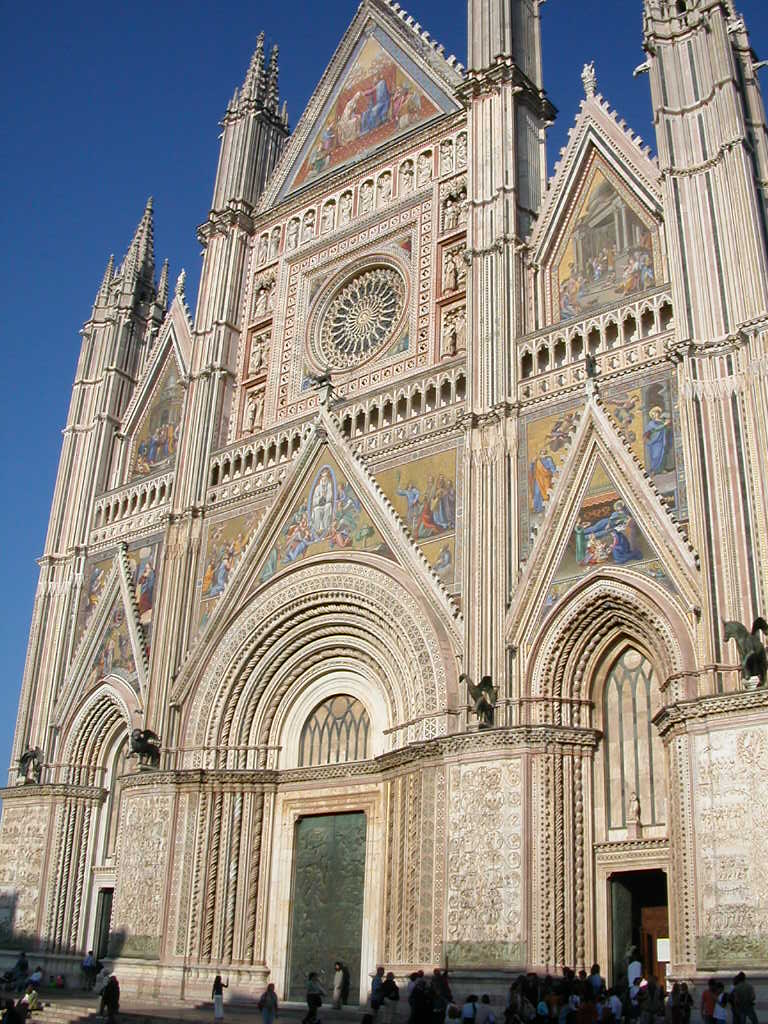
Orvieto - Duomo

Spectacular is the cathedral of Orvieto . As a result of a blood miracle (the Host was bleeding in the conversion, the blood-stained corporal is preserved and revered to this day) was built new in 1300 the cathedral. The Pope, who resided at that time was practically in Orvieto, which properly do so, and then a Romanesque-Gothic church beautiful Italian style (ie: Gothic did not understand) of enormous dimensions and were made with a premium facade . The cathedral stands like a giant reliquary of the city. The spacious interior
directed to the chapel of the left and corporals St. Brictius Chapel right, moving the frescoes from the end of the day by Luca Signorelli at the beginning of the Renaissance are.
Unfortunately, there has been on transferring photos to the computer an error, so I refer here only to images on the net can. It's worth it!

School Project Building A Castle

Ravenna

The city of Ravenna (say, Germans, of course, "Raven" to) is a pre-Roman foundation. At the end of the Western Roman Empire, it reaches for its strategic location, the status of a manor house - both for the Western Romans, as well as the Goths, and for the Byzantines. From this very moving and historically significant churches crucial time in an incredibly good condition are obtained. impressive addition to the excellent architecture, especially the mosaics, which offer us a kind of "color photos" Insights into the world at that time, their devotion and splendor.
Here lies buried the way Dante, what the Florentines are still not speak well, but at least the oil for the lamp in his mausoleum donate.